13 November
Rediscovering Bernardo Pasquini: Manuscript Sources, Musical Symbolism and Historical Performance
Report from Gothenburg International Organ Festival - Announcement of Critical Edition
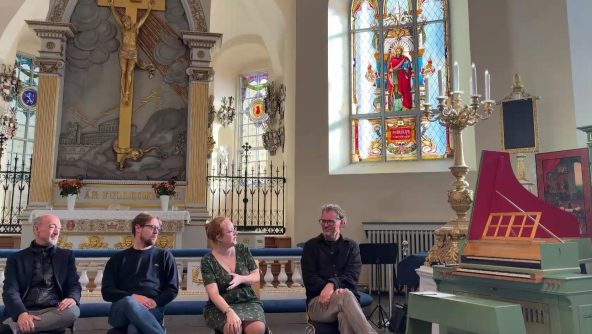
Workshop and Seminar | 14 October 2026 | German Church, Gothenburg and Ohlin Hall, Artisten | Gothenburg International Organ Festival
On 14 October 2026, the German Church in Gothenburg hosted a workshop and seminar devoted to Bernardo Pasquini (1637–1710) as part of the Gothenburg International Organ Festival. The day brought historical scholarship into conversation with practical music-making, with a central focus on the forthcoming critical edition of Pasquini’s oratorio Sant’Agnese, prepared by Elia Pivetta.
Contributions from Elia Pivetta, Joel Speerstra, Eleanor Smith-Guido, Magnus Kjellson, alto Amanda Flodin, Alessandro de Marchi and Karin Nelson explored manuscript transmission, historical instruments, improvisation, pedagogy, symbolism and performance.
Morning Workshop: Sant’Agnese — From Critical Edition to Performance
The morning workshop centred on the forthcoming critical edition of Bernardo Pasquini’s Sant’Agnese, currently being prepared by Elia Pivetta, and the musical and interpretative questions arising from his research into the surviving manuscript sources.
A particular focus was the relationship between the Vienna and Modena manuscript versions. Although they transmit substantially the same work, the sources reveal differences in their basso continuo parts, harmonic writing and treatment of bass lines. In some passages, the Modena source presents simplified or reworked bass lines compared with Vienna, raising questions about the circumstances in which the versions were transmitted and performed.
Pivetta’s ongoing editorial research and comparison of these sources provided a starting point for the workshop’s practical investigations. The discussion considered how editorial decisions and historical performance practices intersect, and whether instrumental resources in different historical settings might help explain some of the variations.
Eleanor Smith-Guido chaired the workshop and seminar and contributed to discussions of historical keyboard instruments. Participants considered organs, harpsichords and other continuo instruments available in seventeenth-century Rome and Modena, including how differences in range and capability might have shaped musical practice.
Magnus Kjellson and alto Amanda Flodin brought the music to life through performance demonstrations, allowing participants to hear and discuss the interpretative consequences of different readings. Magnus also reflected on the practical challenges and artistic choices involved in working with the sources.
Alessandro de Marchi shared insights from his previous experience performing and recording Sant’Agnese, offering a further perspective on the musical qualities of the versions and the decisions facing performers.
The workshop demonstrated the value of bringing editorial research into direct dialogue with practical music-making. Differences that appear relatively small on the page can matter considerably in a tradition where basso continuo realisation, ornamentation and improvisation are integral to performance. Pivetta’s edition is planned to be made available through the rem@ke portal; publication details will follow.
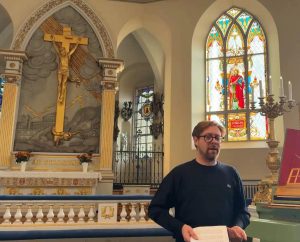
Elia Pivetta discusses the pedagogical nature of keyboard manuscripts compiled by Pasquini.
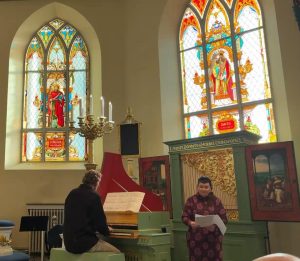
Magnus Kjellson and Amanda Flodin demonstrate arias from Pasquini’s Sant’Agnese
Afternoon Seminar: Improvisation, Symbolism and Pasquini’s Musical World
The afternoon seminar broadened the focus from the practical exploration of Sant’Agnese to the pedagogical, cultural and intellectual traditions surrounding Pasquini and his contemporaries.
Historical Improvisation and Pedagogy — Karin Nelson
Karin Nelson discussed the history of improvisation pedagogy and its surviving sources, drawing on her collaboratively developed research project with Peter van Tour and Mattias Lundberg: Unlocking the Art of Composition: Playing with Purposefully Incomplete Keyboard Notations in Northern Europe (2026–2028), supported by the Swedish Research Council.
The project investigates how deliberately incomplete keyboard notations could support the teaching and practice of improvisation and composition. Karin’s presentation offered a complementary perspective on the relationship between written pedagogical materials and the practical knowledge expected of historical musicians, with connections to Pasquini’s teaching traditions.
Project information: https://www.gu.se/en/research/unlocking-the-art-of-composition
Musical Symbolism and Emblematic Culture — Joel Speerstra
Joel Speerstra explored symbolism surrounding Pasquini’s music through the tradition of emblem books, in which images, classical mythology and allegorical meanings interact. Taking the cuckoo and its associations with Greek mythology as a point of departure, he considered how musical and natural imagery could carry multiple layers of meaning for seventeenth-century audiences.
His presentation connected musical references with the visual and literary culture of the period and concluded by identifying “Il Scozzese” as John Clerk of Penicuik, suggesting an intriguing link between Pasquini’s world and Scotland.
Sant’Agnese: Dramaturgy, Composition and Musical Language — Elia Pivetta
Elia Pivetta’s afternoon presentation developed the scholarly context of his ongoing work on Sant’Agnese. He examined the oratorio’s devotional and dramatic setting, its characters and musical structure, and aspects of Pasquini’s compositional and pedagogical practice.
The presentation considered how counterpoint, keyboard teaching, accompaniment and improvisation belonged to a closely connected musical culture. Discussion of ornamentation and realisation helped place the manuscript differences examined during the morning workshop within a wider understanding of seventeenth-century musical practice.
These investigations inform Pivetta’s forthcoming critical edition, which brings source comparison, historical context and practical interpretative questions into a shared editorial framework.
Bernardo Pasquini in Context — Alessandro de Marchi
Alessandro de Marchi concluded the afternoon seminar with a broader presentation on Bernardo Pasquini and his musical world. Drawing on his experience as a performer and interpreter of Baroque repertoire, he situated the composer and his music in a wider historical and artistic context, complementing the day’s close attention to manuscripts, instruments and performance.
Connecting Research, Editing and Performance
Across the morning and afternoon sessions, a recurring theme was the relationship between written musical sources and the creative knowledge of historical musicians. The Vienna and Modena manuscripts of Sant’Agnese offer more than alternative readings: they invite questions about transmission, local circumstances and the choices of performers.
The workshop explored these issues through performance, while the seminar connected them to historical pedagogy, emblematic symbolism and Pasquini’s broader musical culture. Together, the contributions demonstrated how editorial scholarship, historical research and practical music-making can inform one another.
Forthcoming Critical Edition
Bernardo Pasquini — Sant’Agnese
| Critical editor | Elia Pivetta |
| Status | In preparation |
| Principal sources under study | Vienna and Modena manuscript traditions |
| Planned availability | Peer-reviewed Open Access – REM@KE portal, (and others) |
| Publisher | To be announced |