24/04/2026, at 17:00
Madeleine Modin – Permanent Seminar Series – April 24, 17:00 CEST / 16:00 BST
REM@KE Permanent Seminar Series | Madeline Modin | Makers’ choices of materials in traditional folk music instruments
Description of the event
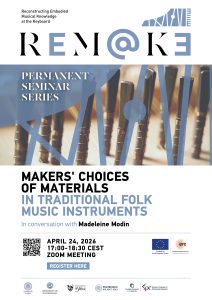
Join us to the next seminar of the REM@KE Permanent Seminar Series with our third guest speaker, Madeleine Modin, on Friday, April 24, starting at 17:00 CEST / 16:00 BST.
Makers’ choices of materials in traditional folk music instruments
Abstract:
This presentation will address factors influencing material choice in folk instrument making. The building of traditional folk music instruments is tangled with many alternatives concerning their design. Historical authenticity and traditions from different times and places are at the core, but playability and shifting aesthetical matters are also central when the instruments are supposed to be played on. In the choice of materials, the maker not only considers the above-mentioned aspects, but also takes prices, accessibility, and durability into account, as well as notions of materials’ value with regards to morals and ideologies. Another aspect is the maker’s loyalties to predecessors and mentors in both the older traditions as well as in the more recent revival traditions. Who is building and who is going to play on the instrument is also of great importance in the choice of materials.
In this seminar, Modin will present some findings from a research project in which the aim was to get a deeper understanding of driving forces and thinking in revival movements, but also to highlight the constraints imposed by physics and economics. She has studied not only the building of traditional folk music instruments in Sweden today, but also the development of different instruments in revivals during the last half century.
The primary example in this presentation will be drawn from the revival of a traditional Swedish bagpipe, with a revival process starting already in the 1940’s, but with a strong development and dissemination from the early 1980’s. Another example will be that of the nyckelharpa (keyed fiddle) and its strong network of builders and musicians.
The results are based on both previously-existing and newly-made qualitative interviews with instrument makers. The study also includes elements of digital ethnography of instrument-making communities, with analysis of statements and discussions on social media and websites. Archive materials include instrument makers’ personal archives and documentation from instrument building courses, as well as the existing instruments themselves.
The research project Intangible instrument building as folk musical materialization was conducted at Svenskt visarkiv (Centre for Swedish Folk Music and Jazz Research) and funded by Riksantikvarieämbetet (The Swedish National Heritage Board) 2021–23. The results will be presented in a monograph later this year.
In this seminar she is presenting some results from the research project Intangible instrument building as folk musical materialization, funded by Riksantikvarieämbetet (The Swedish National Heritage Board) 2021–23.
Invited speaker Bio:
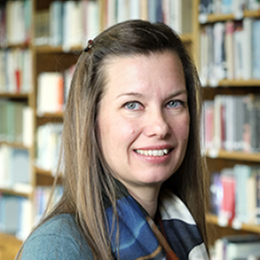 Madeleine Modin, PhD in musicology, holds a position as research archivist at Svenskt visarkiv, (Centre for Swedish Folk Music and Jazz Research) in Stockholm, Sweden. The institution is part of the Swedish Performing Arts Agency, which also includes Scenkonstmuseet (the Swedish Museum of Performing Arts, earlier Musikmuseet). She has earlier worked at Musikmuseet (1999–2002, 2006) and the Nydahl collection (2018-19). Her research interests include revivals, cultural heritage questions, collecting and playing historical instruments, musical instrument building, and different aspects of vocal and instrumental Swedish traditional music.
The study Perceptions and Presentations of historical musical instruments. A Study of the Stockholm Museum of Music History, 1899–1918 (doctoral thesis Stockholm University 2018) was for a period part of the research project Pluralize or Polarize: About cultural heritage, identity and popular education (2011–14). Another study was about the history of Vispråmen Storken, the most important club and stage for singer-songwriters/troubadours in Stockholm in the 1960’s, conducted within the research project Creative Shifts – Musical Flows in 1960s and 1970s Sweden (2017–20).
She is General Editor of Puls – Journal for Ethnomusicology and Ethnochoreology, Chair of the Swedish committé of ICTMD and Vice Chair of Svenska samfundet för musikforskning (Swedish society of music research).
To know more about Madeleine’s work, visit: https://svensktvisarkiv.se/en/research/madeleine-modin/.
Fill this form to register and join the seminar!
Location
Zoom online meeting